
On the morning of 15 August 1982, Prime Minister Indira Gandhi climbed the ramparts of the Red Fort to deliver the Independence Day address, a ritual that had repeated itself every year since 1947. What made that particular broadcast different had nothing to do with her words. For the first time, Doordarshan carried the speech and the 35th Independence Day celebrations to television sets across the country in colour. That single transmission, more than the Asian Games that followed it three months later, marks the true beginning of colour television in India.
The Asian Games get most of the credit in popular memory, and not without reason: they gave colour broadcasting its first mass audience and its first genuine spectacle. But the actual switch, the moment Doordarshan’s national signal stopped being black and white for good, happened on Independence Day. Understanding why means looking past the sporting event and back at a broadcaster that had spent more than two decades finding its feet.
Two Decades in Black and White
Doordarshan’s story began quietly on 15 September 1959, when All India Radio launched an experimental television service from a modest Delhi studio with a transmitter that barely reached beyond the city. For years, it stayed exactly that: an experiment, aimed mostly at schools and farmers, running for a few hours a day. Regular daily transmission did not begin until 1965, when newsreader Pratima Puri read India’s first five-minute television bulletin. Krishi Darshan, still Indian television’s longest-running programme, followed on 26 January 1967.
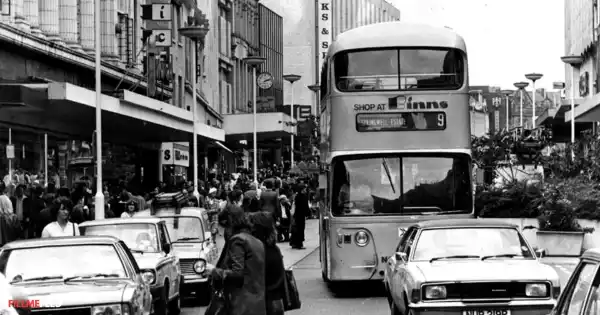
Growth was slow by design. Television reached Bombay and Amritsar only in 1972, and by 1975 just seven Indian cities had any television service at all, every one of them watching in black and white. On 1 April 1976, Doordarshan was formally separated from All India Radio, given its own director-general and a mandate to grow into something more than a radio broadcaster with pictures attached. Even so, going into the 1980s, colour television in India remained something people read about or saw on trips abroad, not something that existed inside their own homes.
The Quiet Test Nobody Announced
Colour did not arrive all at once. On 25 April 1982, Doordarshan Delhi quietly ran its first colour test transmission, an unannounced technical trial with none of the ceremony that would follow four months later. It reached only the small number of colour sets already present in the country at the time, largely owned by diplomats, returning NRIs and a handful of well-connected buyers, and it was treated internally as a rehearsal rather than a broadcast meant for the nation.
This detail matters, because it is often lost in the shorthand version of the story that credits the Asian Games with inventing colour television in India overnight. The Asian Games did not introduce colour broadcasting to the country; they scaled it up spectacularly. The nationwide, public and symbolically loaded switch happened on Independence Day, with the April test serving as its quiet dress rehearsal.
15 August 1982: The Independence Day That Changed the Screen
On 15 August 1982, Doordarshan launched a national colour telecast service from its studio at Mandi House in Delhi, using the PAL colour system, and carried Indira Gandhi’s Independence Day address along with the Red Fort celebrations to viewers across India in colour for the first time on a national scale. That same year, Doordarshan had already been designated the country’s national broadcaster, and the Independence Day telecast effectively announced that new identity to the public: a single, unified channel now capable of reaching the country in something closer to how the world actually looked.
The timing was not incidental. Independence Day carries enormous symbolic weight in India, and putting the switch to colour on that date turned a technical upgrade into a piece of national theatre. The tricolour, the Red Fort ramparts, the crowds gathered below: all of it appeared in colour on the very day the nation marked thirty-five years of independence. It is hard to think of a more deliberate pairing of technology and patriotism in the history of Indian broadcasting.
There is a small, telling detail that rarely makes it into the retellings. Chitrahaar, the twice-weekly programme of Hindi film songs that would go on to define an entire generation’s relationship with cinema music, launched on Doordarshan on that very same day, 15 August 1982. India’s television audience did not just gain colour that day. It gained one of the shows that would keep families in front of the set for the rest of the decade.
The Asian Games and the Great Colour TV Rush
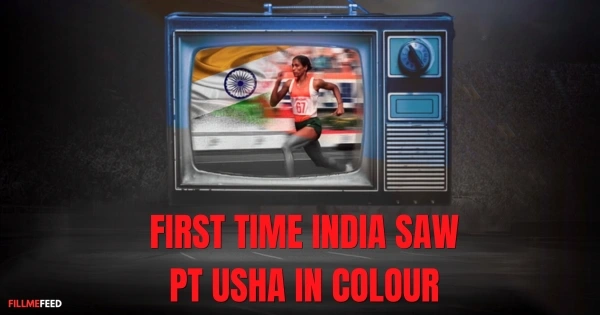
If Independence Day was the switch being flipped, the Ninth Asian Games, held in New Delhi from 19 November to 4 December 1982, was the moment the whole country noticed. The Union Government permitted the import of 50,000 colour television sets ahead of the Games, a quota quickly overtaken by demand. By the time the dust settled, closer to a lakh sets had entered the country, earning the government an estimated Rs 70 crore in customs revenue alone. Indian-made sets sold for around Rs 8,000, imported ones for as much as Rs 15,000, at a time when either figure represented a genuinely serious household purchase.
Information and Broadcasting Minister Vasant Sathe is widely credited as the driving force behind the switch, having returned from a visit to France convinced that colour broadcasting could modernise Indian television rather than remain an unaffordable luxury for a developing country. Critics argued India had more urgent priorities than coloured pictures. Sathe’s answer was later paraphrased by former Doordarshan director-general Bhaskar Ghose in an interview with India Today: colour, Ghose said, “was just a metaphor for a switchover to high technology.”
Whatever the argument, the appetite was real. Families who did not own a set crowded into the homes of neighbours who did, turning front rooms, verandahs and courtyards into informal cinema halls for the length of the Games. Television transmitters across the country jumped from 35 to 100 that year, an infrastructure leap that colour broadcasting, more than anything else, forced into motion.
From One Broadcast to a National Habit
The Independence Day switch and the Asian Games spectacle together did something more lasting than sell television sets: they turned Doordarshan into appointment viewing for the whole country. Chitrahaar had already arrived on day one. Hum Log followed on 7 July 1984, India’s first television soap opera, a 154-episode chronicle of a lower-middle-class family that Doordarshan commissioned after officials studied the Mexican serial Ven Conmigo and adapted its format for an Indian audience. Ramesh Sippy’s Buniyaad arrived soon after, tracing a family’s journey through Partition and its aftermath at a scale black-and-white television could never have carried convincingly.
Malgudi Days, Shankar Nag’s gentle adaptation of R.K. Narayan’s short stories, brought a fictional South Indian town into households across every language region from 1986 onward, its sun-baked, unhurried visuals depending entirely on colour to do their work. Then came Ramanand Sagar’s Ramayan, which ran from 25 January 1987 to 31 July 1988 on Sunday mornings and, by multiple contemporary accounts, emptied streets and delayed public transport across the country while it aired.
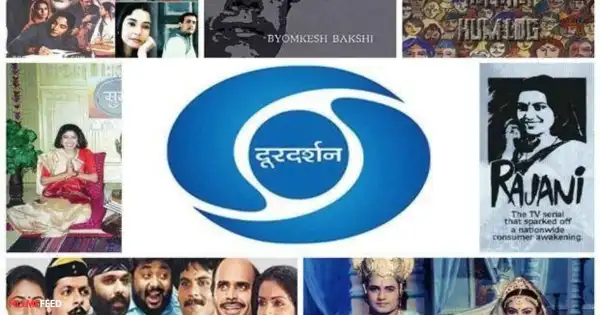
None of these shows would have carried quite the same weight in black and white. Costume, set design and cinematography suddenly had a reason to matter on Indian television, because colour finally gave them somewhere to be seen, and the programmes commissioned through the mid-1980s were built with that in mind from the outset.
Why the Independence Day Broadcast Still Deserves the Credit
It is easy to see why the Asian Games absorbed most of the popular memory. Sport photographs well, drew a larger single audience, and gave the switch to colour a clean, dramatic occasion to be remembered by. But the Independence Day broadcast did the harder, less photogenic work of making colour television a national institution rather than a sporting novelty. It tied the technology to citizenship and shared history rather than to a one-off event, and it is difficult to separate that choice of date from the seriousness with which Doordarshan approached its programming for the rest of the decade.
More than four decades on, in a country where streaming platforms compete for attention across a dozen screens in a single household, it is worth remembering that Indian television’s most significant technological leap arrived on a date already loaded with national meaning. Before cable, before satellite, before anyone in India had heard the word OTT, one Independence Day quietly rewired what an entire country expected from its television set.
Frequently Asked Questions (FAQs)
1. When did colour television actually begin in India?
Colour television in India began nationally on 15 August 1982, when Doordarshan telecast Prime Minister Indira Gandhi’s Independence Day address and the Red Fort celebrations in colour for the first time on a national scale.
2.Was the 1982 Asian Games the first colour broadcast in India?
No. The Asian Games, held in New Delhi from 19 November to 4 December 1982, were the first major sporting event broadcast in colour, but the switch to national colour telecasting had already happened three months earlier, on Independence Day.
3.Was there any colour transmission before 15 August 1982?
Yes. Doordarshan Delhi ran a quiet, unannounced colour test transmission on 25 April 1982. It was a limited technical trial, not a national public broadcast.
4. How much did a colour television set cost in India in 1982?
Indian-manufactured sets cost around Rs 8,000, while imported sets cost as much as Rs 15,000, at a time when the government had permitted the import of 50,000 sets, a quota that was eventually far exceeded.
5. Which Doordarshan shows are linked to the colour TV era?
Chitrahaar launched on the same day as the colour switch, 15 August 1982. Hum Log (1984), Buniyaad (1986), Malgudi Days (1986 onward) and Ramanand Sagar’s Ramayan (1987–88) followed, and are widely remembered as the defining shows of Doordarshan’s colour-era golden age.
About FillmeFeed
FillmeFeed is your go-to destination for the latest updates on Bollywood, Hollywood, Anime, Fashion, Lifestyle, OTT releases, Celebrity News, Movie Reviews, and Trending Stories. We bring readers engaging, well-researched, and up-to-date content from the world of entertainment and pop culture.
FillmeFeed is proudly a part of Fillme Networks, a digital media network committed to creating high-quality content across entertainment, lifestyle, technology, and emerging digital trends.


Pingback: 12 Independence Day Movies That Aren't the Same Five Films Again -