
The music changes before you see anything. That’s usually the first sign. A shot holds a beat longer than it needs to, someone in the frame looks off to one side, and you already know who’s about to walk in. You haven’t seen him yet, but you’re ready. That gap between knowing and seeing is where Bollywood hero entrances actually happen, and directors have been tightening that gap for decades, sometimes with a stunt, sometimes with nothing but a chair being pulled back and a voice.
This isn’t really a ranking of ten scenes. It’s more of an attempt to figure out why some entrances get remembered for twenty years and others, made with just as much money and just as much slow motion, disappear by the following weekend.
The Five Things Every Great Entrance Gets Right
Pull the plot and the year out of it, and most Bollywood hero entrances lean on the same handful of tools, just in different combinations.
Someone talks about the hero before he shows up. A rival says his name with fear in it, or a mother just senses something’s off before she’s even turned around. That’s the build-up doing its job.
Then there’s what the camera won’t show you yet. A boot. A jacket collar. A shadow across half a face. Holding back the reveal for a few extra seconds is what makes the eventual reveal land instead of just registering as a cut.
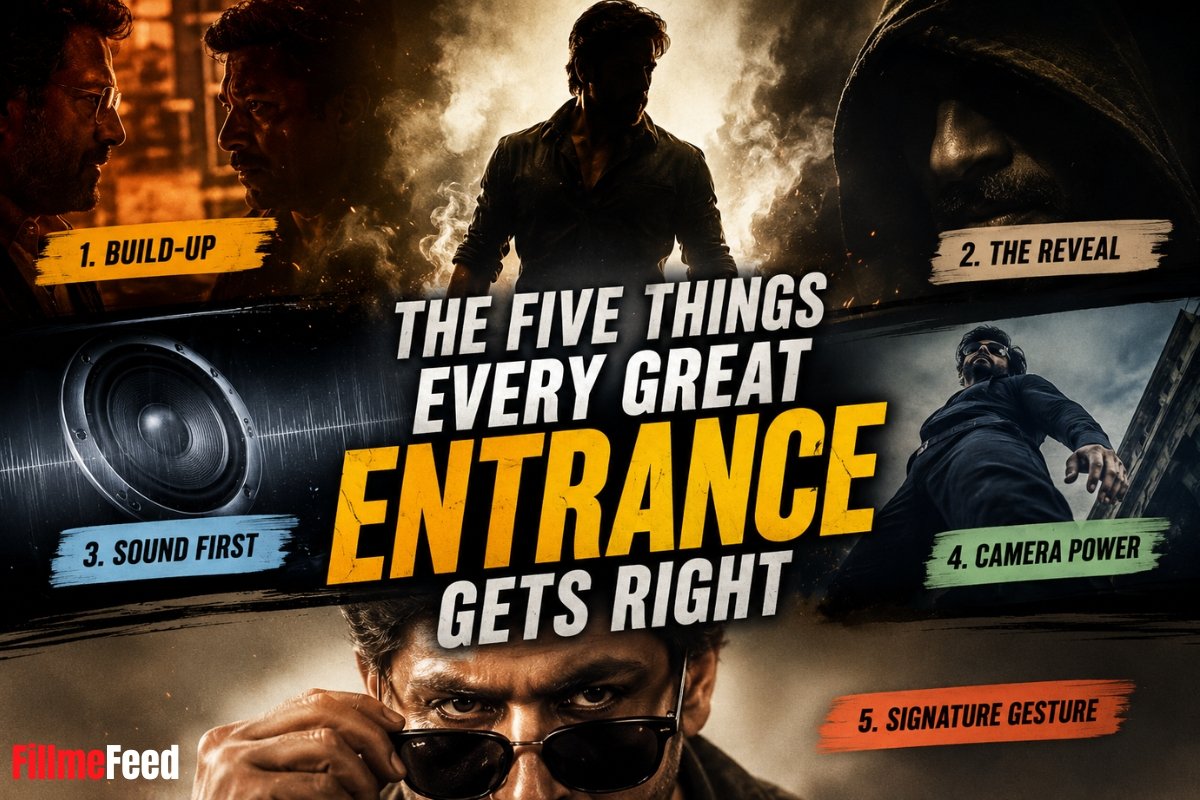
Across most Bollywood hero entrances, sound usually gets there first. A bass drop, an engine roar, total silence right before the score kicks in hard, it doesn’t matter which, as long as your ears know before your eyes do.
Camera mechanics do a lot of quiet work too. A low angle can make an average-height actor look like he owns the room. Slow motion stretches two real seconds into ten. None of it needs to be complicated. It just needs to be on purpose.
And then, almost always, there’s one gesture that sums the whole character up. Sunglasses coming off. A smirk held a beat too long. You don’t need a monologue when the gesture already told you everything.
Ajay Devgn’s Two-Bike Entry in Phool Aur Kaante
I still find it a little ridiculous, in a good way, that this stunt was real. In 1991, a debutant actor stood with one foot on each of two motorcycles running side by side at speed, no CGI, no safety cable the camera would let you see. Veeru Devgan, Ajay Devgn’s father, choreographed it himself, and the two bikes had to hold near-identical throttle for the whole shot to work. One wrong twist of the wrist and it’s a hospital visit instead of a career launch.
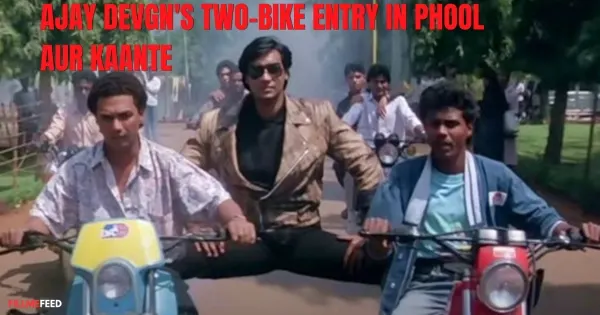
What actually sells the scene isn’t the danger, it’s how bored Devgn looks doing it. Black leather jacket, dark jeans, aviators, an expression that says this is basically a Tuesday for him. The camera tracks him backward from a low angle, giving the split just enough room to register, and that two-bike image became something he kept coming back to for years after. A lot of Bollywood hero entrances since have chased this same stripped-down danger and rarely matched it. This one didn’t have the option of faking it, and it’s better for that.
Hrithik Roshan Makes War Look Effortless
A helicopter lands. A man steps out in a faded olive jacket, wipes some dust off his forehead, and that’s more or less it. Major Kabir Dhaliwal doesn’t fight anyone in this scene. He doesn’t say anything worth quoting. Tiger Shroff’s character just watches him from across the pad, and the way he watches tells you more than dialogue would.
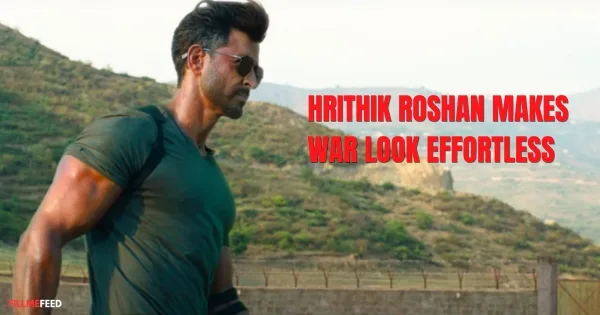
Most Bollywood hero entrances go loud. Siddharth Anand bets this one entirely on the idea that Hrithik Roshan standing still is more interesting than most actors running. It’s a strange bet to make and it pays off completely. The helicopter blades fade into a low bass hit, then an acoustic guitar riff comes in under him while the camera holds him in slow motion, backlit, dust catching the light around his shoulders. Doing almost nothing turns out to be the hardest thing to pull off convincingly, and War trusts an actor who can actually do it.
Shah Rukh Khan Brings Pure Emotion to K3G
No stunt here, no slow walk toward the camera. Just a black helicopter touching down on a family estate, and a mother who feels her son is home before she’s even looked toward the door. Jaya Bachchan’s character senses Rahul’s arrival the way you’d notice a change in room temperature, and honestly, that instinct is doing more work in this scene than anything visual.
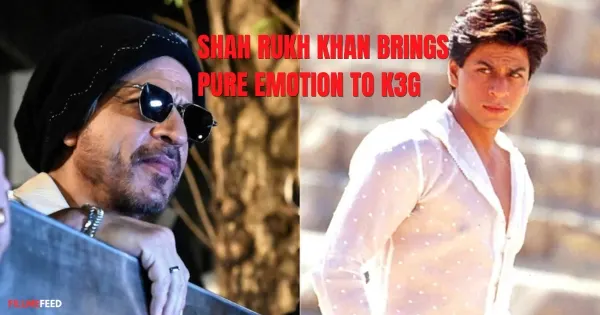
Shah Rukh Khan steps out adjusting his coat as the title track climbs toward its full orchestral peak, and the aarti thali is already out before he’s said a single word. Among Bollywood hero entrances that skip the fight scene entirely, this one might be the clearest proof that a family simply recognizing its own can fill a theatre with more feeling than a punch ever could.
Jawan Turns Shah Rukh’s Entry Into a Full Event
Rain. Lightning. A bandaged, bloodied man alone against a group of armed mercenaries, holding a spear wrapped in cloth. Of all the Bollywood hero entrances Shah Rukh Khan has had across thirty years, nothing in his back catalogue looks like this, and that’s clearly the point.
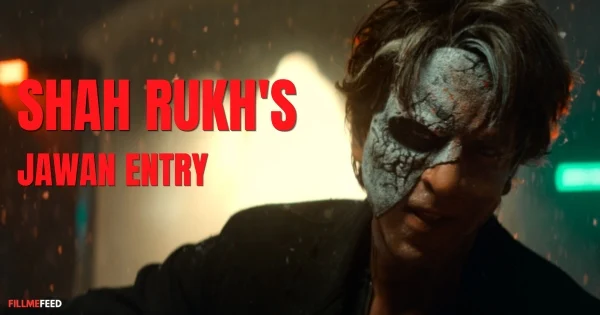
The fight runs at 120 frames per second, so every movement stretches out long enough to actually study, then snaps back to real time hard enough to jolt you. Anirudh Ravichander’s score leans electronic and aggressive, closer to what you’d hear in a South Indian mass-action film than a traditional Bollywood score, and that borrowing isn’t accidental. Jawan doesn’t just introduce a character. It’s SRK’s entrance into a completely different genre of star, thirty years into a career that had never really needed this register before.
Salman Khan Becomes Chulbul Pandey in One Gesture
He smashes through a wooden door mid bank robbery, adjusts his police belt like he’s got the whole day free, and smirks at everyone in the room, cops and robbers both. Within about fifteen seconds you understand Chulbul Pandey isn’t going to behave like a normal policeman, and he never does for the rest of the film. Dabangg belongs to a run of Bollywood hero entrances from the early 2010s that leaned almost entirely on attitude over plot, and it still holds up.
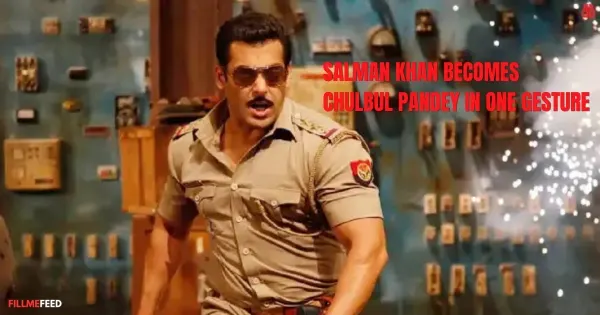
Sajid-Wajid’s brass fanfare and whistle motif carry a lot of the scene, but it’s the collar adjustment people actually remember and imitate. Dabangg more or less revived a stylized cop genre in Hindi cinema off the strength of this single entrance. Sometimes the gesture just is the character, no backstory required.
Amitabh Bachchan Proves You Don’t Need an Action Scene
An interrogation room. A chair pulled back with deliberate slowness. A man sits down and introduces himself, and the voice alone is doing more than any stunt could. Vijay Dinanath Chauhan barely moves in this scene from Agneepath, and it’s still one of the most quoted Bollywood hero entrances of its era.
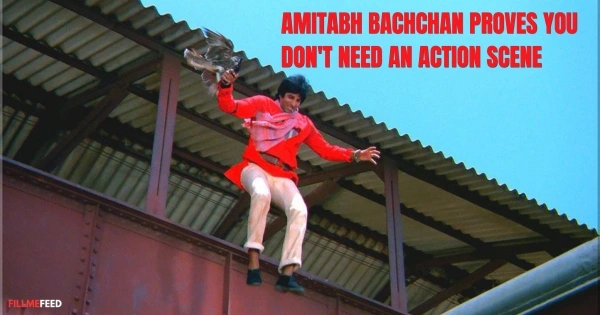
High-contrast lighting carves out the geometry of Amitabh Bachchan’s face, and the camera stays mostly still too, trusting that gravelly cadence to hold the whole room’s attention. This is probably the clearest argument on this entire list that weight beats spectacle. Very few actors can turn stillness into that much pressure.
Hrithik Roshan Turns Into Mr. A in Dhoom 2
A wax statue peels away and it was never wax, just a silicone mask over Hrithik Roshan’s face, mid heist, having already stolen a crown off a bullet train cutting through the desert. Most Bollywood hero entrances sell you a character. This one is selling you an idea of glamour instead, which is a very different job.
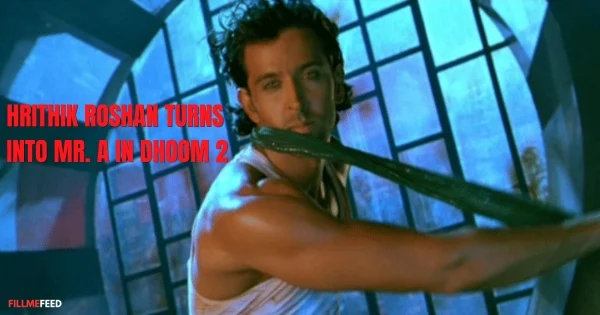
Pritam’s electronic theme and the high-gloss desert visuals lean hard into a heist aesthetic Bollywood hadn’t really tried at this scale before. You’re not being asked to root for Mr. A yet. You’re just being asked to be impressed, and for about ninety seconds, it works.
Ranbir Kapoor Reinvents His Screen Image in Animal
A dark SUV convoy pulls up outside a college campus. A man in a black suit and sunglasses walks a corridor with the kind of composure that reads less like confidence and more like a threat. This is Ranbir Kapoor, whose career up to this point had mostly been built on charm, playing someone who scares a room just by entering it. Not many Bollywood hero entrances are designed to work against the actor’s own image like this one is.
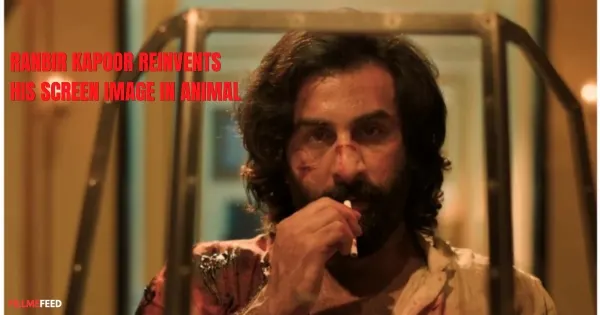
The low-angle corridor walk runs under a bass-heavy Punjabi folk fusion track, and the whole thing is engineered to break whatever you thought you knew about this actor. That’s really the trick behind Ranvijay Singh’s introduction: it isn’t just a character entrance, it’s a deliberate contradiction of a public image built over fifteen years.
Ranveer Singh Steals the Film Before the Hero Does
Dust and scars everywhere. A man tearing into raw meat with his bare hands inside a royal war tent, then pulling down the drapes around him like the room itself has offended him. Alauddin Khilji’s entrance in Padmaavat feels genuinely unpredictable, and he’s the villain of the film.
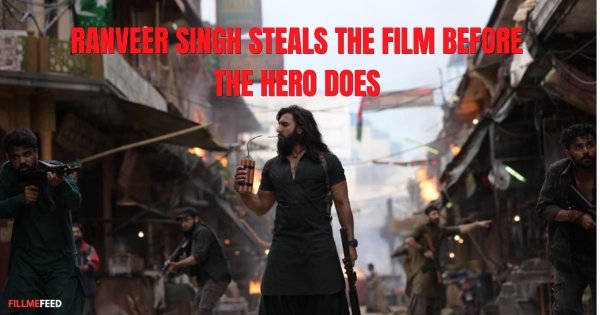
Bhansali scores it with tribal drums and a choral arrangement big enough for a hero twice over, which is worth sitting with for a second. This piece is technically about hero entrances, and yet Padmaavat hands its biggest one to the antagonist without apology. Ranveer Singh makes the case here that presence doesn’t check which side of the story you’re on before it shows up, which is a strange thing to prove inside a list built around Bollywood hero entrances for the good guy.
Akshay Kumar Breaks the Horror Mood in Bhool Bhulaiyaa
Nearly an hour of eerie build-up, a haunted mansion, a family stretched thin with tension, and then Dr. Aditya Shrivastav walks in wearing a yellow kurta and a red bandhani dupatta, stumbling comically over the threshold with a coconut in hand. On paper this shouldn’t work at all, and it’s a rare enough move among Bollywood hero entrances that it still catches people off guard on a rewatch.
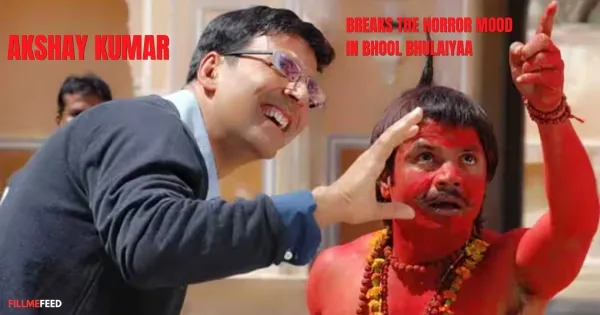
It works completely. Flute motifs and cheerful close-ups puncture every bit of dread the film had spent an hour building, and that’s the entire joke. Most of the other entries on this list are built to raise the temperature in a room. Bhool Bhulaiyaa is the rare case built to drop it, on purpose, right when nobody’s expecting a laugh.
How South Indian Cinema Changed the Bollywood Mass Entry
Jawan’s entrance didn’t appear out of nowhere. Directors like SS Rajamouli, Prashanth Neel, and Lokesh Kanagaraj had spent years redefining what a mass entry could look like further south, and Bollywood clearly noticed.
Prabhas carrying a massive Shivling under a waterfall in Baahubali: The Beginning isn’t subtle, it’s mythic by design, treating physical strength and devotion as the entire vocabulary of the introduction. Yash’s entrance in K.G.F leans into darkness, gunfire, and smoke, using contrast instead of clarity to build the character. RRR goes bigger still, sending Ram Charan to face down a massive crowd while Jr NTR captures a tiger with his bare hands, fire and water as competing identities for two men who’ll end up friends. None of these read like restrained character writing. They read closer to religious iconography. Once Bollywood hero entrances started pulling from this scale, from Jawan’s combat sequence to Animal’s corridor walk, the whole genre got noticeably louder and more physical than the emotional or comic entrances that used to dominate.
Why We Still Wait for the Hero to Arrive
None of this works without an unspoken deal between filmmaker and audience. The director is basically saying: you already know who’s coming. The audience says: fine, make me wait for it properly. That delay is the entire transaction, and it only pays off because everyone in the room experiences it at the same second.
You already know Shah Rukh Khan is going to walk into K3G. That’s never the surprise. What you’re actually waiting for is how the scene chooses to deliver him, the exact music cue, the specific camera angle, the one gesture. It’s a bit like watching a magic trick whose mechanics you already understand and enjoying it anyway. Recognition, a shared reaction across a full theatre, the simple pleasure of knowing something big is coming, that combination is most of what keeps Bollywood hero entrances working decades after the first ones were shot.
Conclusion
A great entrance doesn’t need the biggest budget in the film. Sometimes it’s two motorcycles and a leather jacket. Sometimes it’s a chair being pulled back slowly enough to matter. Sometimes it’s a coconut and a terrible sense of timing that turns out to be exactly right. What ties the strongest Bollywood hero entrances together isn’t scale so much as specificity, one clear choice that tells you who somebody is before they’ve said a word.
What sticks with me, watching all ten back to back, is how differently each director solved basically the same problem. Nobody copied the answer next to them. And even knowing exactly what’s coming, going back to any of these scenes still works, which might be the actual trick behind a good entrance. It was never about the surprise. It just has to deliver when it says it will.
Frequently Asked Questions (FAQs)
1. What makes a Bollywood hero entrance memorable?
A memorable entrance usually combines a strong build-up, controlled reveal, impactful sound design, purposeful camera movement, and a signature gesture that immediately communicates the character’s personality.
2.Why is the build-up important in a hero entrance?
The build-up creates anticipation before the hero appears. Dialogue, reactions from other characters, music, or small visual details can signal that someone important is about to enter, making the eventual reveal more satisfying.
3. How does sound make a hero entrance more impactful?
Sound often introduces the hero before the audience sees them. A bass drop, engine roar, dramatic silence, or powerful background score can create anticipation and make the reveal feel larger.
4. Why do Bollywood films use slow motion during hero entrances?
Slow motion gives the audience more time to absorb the character’s arrival. It can turn a brief action into a dramatic visual moment and emphasize the hero’s confidence, physicality, or presence.
5. What role does the camera angle play in a hero entrance?
Camera angles can change how powerful or imposing a character appears. Low-angle shots, tracking shots, close-ups, and carefully timed reveals can make an entrance feel more commanding without requiring complicated action.
6. What is a signature gesture in a Bollywood hero entrance?
A signature gesture is a simple action that captures the character’s personality. Examples include adjusting sunglasses, removing them, fixing a collar, or holding a smirk for an extra beat.
About FillmeFeed
FillmeFeed is your go-to destination for the latest updates on Bollywood, Hollywood, Anime, Fashion, Lifestyle, OTT releases, Celebrity News, Movie Reviews, and Trending Stories. We bring readers engaging, well-researched, and up-to-date content from the world of entertainment and pop culture.
FillmeFeed is proudly a part of Fillme Networks, a digital media network committed to creating high-quality content across entertainment, lifestyle, technology, and emerging digital trends.

Pingback: Hindi Movie Remakes: 7 South Indian Films That Became Bollywood Hits -