Spoilers ahead for Panchayat seasons 1 to 4 and the ending of Adarsh Baal Vidyalaya.
Mohan Bhargav lands in a dusty Indian village, opens his laptop, and starts fixing things. That was the template Swades gave Hindi cinema in 2004: the returning outsider armed with conscience and a NASA salary, who sees what the village cannot see about itself. It is a good film and a deeply flattering one, because it lets the audience believe that institutional failure is mostly a failure of will. Panchayat and Adarsh Baal Vidyalaya take a more complicated view of that same idea. Instead of outsiders arriving with a clear mission to transform a broken institution, both shows follow reluctant government functionaries whose personal ambitions and everyday compromises end up shaping the institutions they are supposed to serve. failure of will.
Abhishek Tripathi has no such conviction, he arrives in Phulera with a CAT preparation book, a resentment about missing a corporate job. And a single working plan – survive two years as Gram Panchayat Secretary, ace his entrance exam, and never see this village again. He does not want to fix Phulera he wants to leave it.
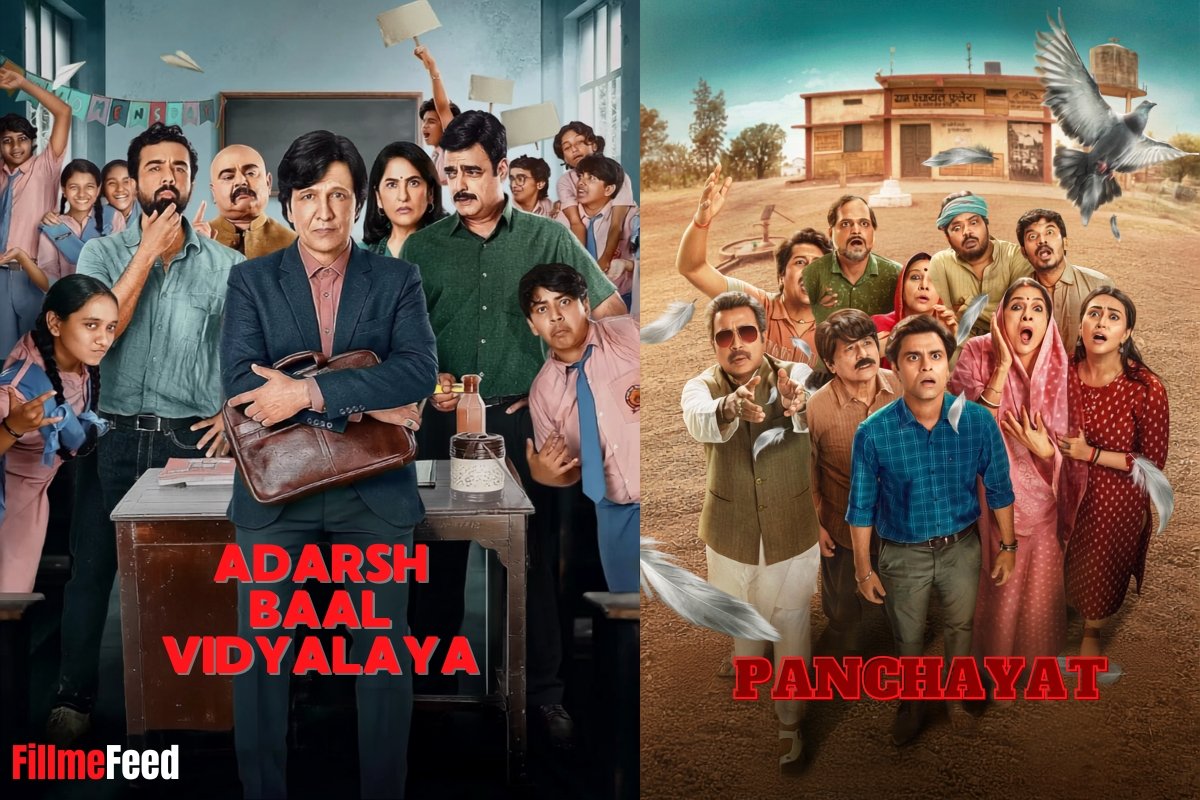
That gap between Bhargav and Tripathi is the real subject of Panchayat, and it is now also the subject of Adarsh Baal Vidyalaya. The Kay Kay Menon-led Prime Video series about a headmaster whose entire school-reform drive is powered by his hunger for a government-funded trip to Cambridge. Watched together, the two shows describe a specific and recognisable figure in Indian institutional life: the reluctant functionary who improves things almost as a side effect of trying to escape.
The Technocrat Who Wanted Out
Panchayat created by TVF and written by Chandan Kumar, has spent four seasons resisting the pedagogical instinct that shapes so much village-set Hindi drama. Jitendra Kumar’s Abhishek does not carry a notebook of civic reforms into Phulera’s panchayat office, he carries irritation. His interventions in village life are triggered almost exclusively by things that threaten his own peace. Noise outside his window during a study session, a squabble that has dragged on long enough to become his problem. An inspection that could put a black mark on his service record.
This is closer to what political scientists call street-level bureaucracy than it is to heroism. Abhishek’s output is shaped by exhaustion, by the tools he happens to have and by the shortest route back to his room. Public goods do get delivered under his watch: a solar streetlight gets installed, sanitation numbers improve, a CCTV network goes up. But in each case, the show is careful to show the transactional root of the decision, not a moment of moral clarity.
Take the streetlight. The block office sends Phulera a single solar lamp, and rather than settling on a location using anything resembling public interest, rival factions start lobbying to have it placed in their own lane, because proximity to infrastructure signals proximity to power. Abhishek has no stake in that contest. He resolves it by placing the light outside the Pradhan’s house, on the flimsy administrative logic of “protecting Panchayat property”, mainly because the arguing outside his office window is cutting into his reading time. The public good happens, but it happens as a by-product of a bureaucrat trying to get some quiet.
The same logic runs through the show’s most quoted subplots: the tug of war over the office’s one cushioned revolving chair, requisitioned for a groom’s wedding procession because rural authority is, in that moment, physically represented by a piece of furniture; and the early-morning shaming patrols organised to hit an Open Defecation Free target before a District Magistrate’s visit, which are about avoiding an adverse entry on Abhishek’s file far more than they are about public health. Panchayat never pretends these are acts of civic virtue. It shows a system that produces outcomes anyway, powered by self-interest rather than despite it.
Also Read: Mirzapur: The Movie Casts Jitendra Kumar as Bablu Pandit
Gyaneshwar Tripathi and the Cambridge Trip
Adarsh Baal Vidyalaya which premiered on Prime Video on 24 July 2026, applies almost the identical mechanism to a different institution. Kay Kay Menon plays Gyaneshwar Tripathi, the laid-back headmaster of a struggling government school in the fictional Delhi-adjacent locality of Tinki Toli. Gyaneshwar’s motivation for turning the school around is not idealism. It is a government-sponsored teacher training programme in Cambridge, unlocked only if the school climbs into the top ten in its category.

Created by Biswapati Sarkar and Sameer Saxena for their Posham Pa Pictures banner, and directed by Himank Gaur. The seven-episode series surrounds Menon with an ensemble that includes Archana Puran Singh as Urmila Devi, Naveen Kasturia as teacher Mukul Dengla, and Deven Bhojani as Goldy, a corrupt local MLA who treats the school primarily as a source of rally crowds and political leverage. The parallel to Phulera’s power structure is direct: an official mandate (educating children) sits underneath a real, unstated incentive (personal advancement), and the whole machine is watched over by a local power broker who wants the institution’s resources for himself.
Where the two shows genuinely diverge is in how far their protagonists travel. By the end of Adarsh Baal Vidyalaya‘s first season, Gyaneshwar reaches a point Abhishek has not yet reached in four seasons of Phulera. Having briefly considered withholding weaker students’ hall tickets to protect the school’s ranking, he reverses course and returns the admit cards in time. When Goldy pushes him to keep using students for political rallies, Gyaneshwar refuses, even though Goldy responds by threatening the jobs of Gyaneshwar and his teaching staff, including Kanchan, played by Prasanna Bisht. It is a headmaster choosing his students over his own Cambridge ambitions, at real professional cost. Abhishek’s arc, at least through the events of Season 4, has not asked him to give up nearly that much.
Also Read: Adarsh Baal Vidyalaya Character Review: Why Its Flawed Characters Make the Show Work
The Micro-Clientelism Problem
What makes Panchayat durable as satire rather than as gentle village comedy is its precision about how power actually moves through Phulera. The 73rd Constitutional Amendment reserved a share of panchayat seats for women. And the show does not pretend that reservation automatically produces representation. Neena Gupta’s Manju Devi holds the title of Pradhan. Raghubir Yadav’s Brij Bhushan Dubey her husband, holds the office desk, negotiates with contractors, and chairs the meetings that matter. Abhishek does not challenge this arrangement, commonly described in political discourse as Pradhan-Pativad, because doing so would cost him the one thing he actually wants from Phulera to be left alone. Instead he coaches Manju Devi through the basics ahead of inspections, treating the illegality as a fact of the landscape rather than a problem to solve.
Around that core sits a small, self-interested support structure. Faisal Malik’s Prahlad Pandey, the Up-Pradhan, trades political loyalty for social standing and evening company. Chandan Roy’s Vikas, the office assistant, trades labour for job security. None of it runs on ideology. Even the show’s produce-based bribery, the laukis that arrive at Abhishek’s door as a kind of soft retainer, works as a running joke about how patronage in rural India is often small, domestic and barely disguised as hospitality.
Adarsh Baal Vidyalaya stages a version of the same dynamic through Goldy and Urmila Devi, who treat the school less as an institution to be improved and more as an asset to be mined for political capital. The comedy in both shows comes from the same source: watching state machinery, however imperfect, get bent around the smallest, most personal grievances of the people in charge of it.
Where Season 4 Left Phulera, and Where Season 5 Goes Next
Panchayat Season 4 arrived on Prime Video on 24 June 2025 and reframed the show’s stakes around a Pradhan election. Kranti Devi, played by Sunita Rajwar, challenged Manju Devi for the post, turning the season into a village-wide contest between the two households. The finale gave the result to Kranti Devi, ending Brij Bhushan and Manju Devi’s hold on the office and leaving Abhishek facing a new, less familiar power centre in Phulera.
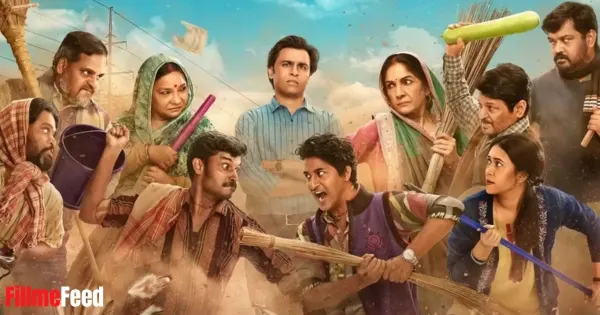
Prime Video confirmed Season 5 in 2026, with Jitendra Kumar, Neena Gupta, Raghubir Yadav, Faisal Malik, Chandan Roy and Sanvikaa all returning, alongside Durgesh Kumar, Sunita Rajwar, Ashok Pathak and Aasif Khan. Reporting around the announcement describes Abhishek navigating a more tense and unfriendly environment under Phulera’s new leadership, while continuing to work towards his MBA plans. No official release date has been confirmed at the time of writing. The shift matters for the show’s central argument: for four seasons, Abhishek’s apathy has functioned as a kind of lubricant precisely because he understood the power structure he was operating inside. Season 5 puts him back in a system where that understanding no longer applies, which is the most direct test the show has set for its own thesis.
The Verdict on the Reluctant Bureaucrat
Neither show argues that apathy is a virtue. What they argue, more carefully, is that an idealistic reformer arriving on day one with a checklist of injustices to fix would likely be met with immediate resistance and would achieve less than a bureaucrat who simply keeps the machine running long enough for small, unglamorous things to get done. Abhishek’s disinterest in local politics means he never becomes a target of it. His grasp of paperwork and English shields Phulera when an aggressive MLA or an unbending District Magistrate comes calling.
The cost of that same disinterest is real. Solving problems through small, tactical compromises, placating the Pradhan’s household here, buying off an opposition figure there, keeps Phulera’s underlying arrangements exactly as they were. Pradhan-Pativad continues. Caste and lane-based patronage continues. The village exploits Abhishek’s literacy with state systems, and Abhishek exploits the village’s silence while he plans his own exit. Panchayat has never pretended this equilibrium is a solution. It has simply, and unusually for Indian television, refused to dress it up as one.
Adarsh Baal Vidyalaya takes the same starting material and, at least by the end of its first season, lets its protagonist choose differently. Gyaneshwar’s decision to protect his students over his own Cambridge trip suggests a genre willing to test how far the reluctant-functionary model can stretch before it breaks into something closer to actual conviction. Whether Panchayat Season 5 pushes Abhishek towards a similar reckoning, now that the household he understood has lost the Pradhan’s chair, is the question the show has spent five years building towards.
Frequently Asked Questions (FAQs)
1.Is Adarsh Baal Vidyalaya connected to Panchayat or made by the same team?
No, Panchayat is created by TVF and written by Chandan Kumar. Adarsh Baal Vidyalaya is created by Biswapati Sarkar and Sameer Saxena under their own Posham Pa Pictures banner and directed by Himank Gaur. Both stream on Prime Video and share a similar institutional-satire sensibility, but they are separate productions with separate casts and creative teams.
2.Where can I watch Panchayat and Adarsh Baal Vidyalaya in India?
Both series are available exclusively on Amazon Prime Video in India with an active Prime membership.
3.Has Panchayat Season 5 been given a release date?
Prime Video confirmed Season 5 as part of its 2026 content slate, with the returning main cast, but no official release date had been announced at the time of writing.
4.Does Gyaneshwar in Adarsh Baal Vidyalaya end up going to Cambridge?
The season’s ending focuses on Gyaneshwar choosing to return students’ hall tickets and standing up to Goldy rather than continuing to chase the ranking needed for the Cambridge programme, at the cost of Goldy threatening his and his colleagues’ jobs.
5. Why does Abhishek not challenge the Pradhan-Pati system in Panchayat?
Show frames it as a pragmatic calculation rather than approval challenging Brij Bhushan’s informal control of the Pradhan’s office. Would create the kind of local hostility that could disrupt Abhishek’s study time and his path out of Phulera. So he works around the arrangement instead of confronting it.
About FillmeFeed
FillmeFeed is your go-to destination for the latest updates on Bollywood, Hollywood, Anime, Fashion, Lifestyle, OTT releases, Celebrity News, Movie Reviews, and Trending Stories. We bring readers engaging, well-researched, and up-to-date content from the world of entertainment and pop culture.
FillmeFeed is proudly a part of Fillme Networks, a digital media network committed to creating high-quality content across entertainment, lifestyle, technology, and emerging digital trends.