
Silence gets used as a cheap flex in a lot of festival cinema, dialogue stripped out so a director can collect praise for restraint they haven’t really earned. 3-Iron Kim Ki-duk’s kept nagging at me because it does not feel like that kind of stunt. Kim Ki-duk’s 2004 film released in Korea as Bin-jip, meaning “empty house,” runs 88 minutes, and its two leads share maybe a dozen words between them across the whole runtime. What convinced me the silence wasn’t a gimmick took a second watch to land properly this is a film about what a home is actually supposed to give a person, and how badly Korean housing at the time was failing to deliver that.
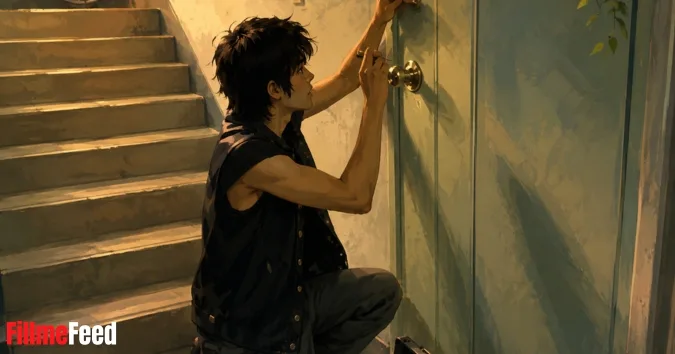
The setup reads like a thriller on paper. Tae-suk, played by Hyun-kyoon Lee, circles the city on a motorcycle taping flyers to apartment doors, and if one goes untouched for a few days, he lets himself in, knowing the place is empty. He’s not there for anything valuable. He fixes the leaking taps, he does the laundry, he waters the neglected plants and he photographs himself using the family’s belongings and leaves before they return. It’s breaking and entering with the moral instincts of a very considerate house guest.
Why the Korean Title Matters More Than the English One
Here’s something that gets lost when English-language coverage only refers to the film as 3-Iron. The Korean title, Bin-jip, has nothing to do with golf. It means empty house, and it’s doing double duty. On the surface it describes the vacant apartments Tae-suk moves through. Underneath, it’s describing the people who live in them, families with every modern comfort and no warmth to speak of. The homes Tae-suk enters are stuffed with electronics and furniture that photographs well. Yet every one of them feels hollow the moment their owners return and resume screaming at each other or ignoring each other entirely.
The international title 3-Iron points at something else the golf club that shows up as both a weapon and a tool of discipline later in the film. Distributors picked the catchier, stranger title for Western audiences. I understand why commercially, but it does change how a first-time viewer approaches the film. Go in thinking “empty house” and you’re primed to notice absence and quiet. Go in thinking “3-Iron” and you’re braced for violence that takes almost an hour to actually arrive.
Also Read: K-Drama Popularity: Why Korean Dramas Are Becoming More Popular Than Ever in 2026
A House Is Not the Same Thing as a Home
Gaston Bachelard spent a good chunk of his career arguing that domestic space works more like psychology than architecture. A house holds memory and a sense of safety long before it holds furniture. His name comes to mind every time I watch Tae-suk move through one of these apartments because that is exactly what he is doing. The legal owners have reduced their homes to storage for status objects. Tae-suk, a squatter with no legal claim to any of it, is the one actually restoring the emotional function of the space. He repairs what’s broken. He tidies what’s been left in disarray. He treats a stranger’s home with more care than its owner does.
This inversion becomes explicit in the film’s most quietly devastating sequence. Tae-suk and Sun-hwa, the woman he eventually falls in with, enter a traditional house and discover an elderly man who died alone, undiscovered for some time. Instead of fleeing, they wash and dress the body, arrange a small altar, and hold a private funeral for a man his own family had apparently forgotten. It’s the one scene in the film where the couple’s “trespassing” stops being morally ambiguous and becomes something closer to sacred duty. Nobody who dismisses this film as a stylistic exercise has really sat with that scene.
Silence as the Only Honest Language Left
Tae-suk never speaks. Not once, in the entire runtime. Sun-hwa, played by Seung-yeon Lee, says a grand total of three words, and she saves them for the final scene. Meanwhile, nearly every other character who does speak uses their voice to control someone. Her husband barks orders. Police officers interrogate. A prison guard issues commands. Language, in this film, is consistently the tool of people with power over people without it.
That pattern is too consistent to be accidental, and once you clock it, it’s not exactly subtle. Jacques Lacan spent a good part of his work on how spoken language locks people into a social order built on rules and hierarchy. And I have no idea whether Kim Ki-duk ever read him, but the film plays out almost like an illustration of that idea anyway. Tae-suk and Sun-hwa are not shy. Their silence reads more like a deliberate exit from a world where opening your mouth has only ever meant telling someone else what to do.
What replaces dialogue is rhythm. The two of them cook without colliding. They settle into matching postures on a sofa without either one initiating it consciously. Their closeness is legible entirely through proximity and timing, which is a harder thing to fake on screen than a good line of dialogue, and 3-Iron Kim Ki-duk trusts his actors and his camera to carry it without a safety net of exposition.
The Golf Club Nobody Wants in Their Bag
If you’ve never spent time on a golf course, a 3-iron has a reputation among players as one of the hardest clubs in the bag to strike cleanly. The loft is low, the margin for error is thin, and it punishes anyone who tries to overpower the shot instead of controlling it. Most viewers won’t consciously register any of that while watching, but the detail is quietly doing its job under the surface.
Sun-hwa’s husband uses his golf clubs the way he uses everything else in his life: as proof of status and as an outlet for rage. There’s an early scene where he swings wildly at her, using the game itself as cover for domestic violence dressed up as leisure. Tae-suk, by contrast, trains with the club almost monastically, hitting balls tethered to a tree with rope, practising restraint rather than power. When he eventually confronts the husband, he doesn’t throw a punch. He drives golf balls at him with the same precision he used in practice, beating a wealthy, controlling man at the exact game the man built his self-image around. It’s one of the more satisfying reversals I’ve seen in a film this quiet.
Also Read: K-Drama Recommendations for Beginners
A Prison Cell, a Blind Spot, and a Kind of Ghosthood
Spoiler warning for the final act below.
Roughly two-thirds through, Tae-suk is arrested and imprisoned. In his cell, he starts practising something genuinely strange: staying inside the guard’s blind spot every time the man does his rounds, slipping behind him, matching his movement, never getting caught in his line of sight. By the time he’s released, he’s turned invisibility into something close to a skill.
What he does with that skill in the final stretch is the part that splits people right down the middle. He goes back to Sun-hwa’s house, where she’s still technically living with her husband, and rather than confronting the man a second time, he just stays there, unseen. He stands right behind the husband. He holds Sun-hwa while her husband sits a few feet away without noticing a thing. It reads less like a haunting and more like someone quietly staking a claim on a life that a marriage certificate and a mortgage were never actually able to protect.
The last shot is the two of them on a bathroom scale, and the needle settles on 0.0 kilograms. A few people I’ve talked to about this film write that number off as a cop-out, an ending too vague to mean much of anything. I’d push back on that. Kim Ki-duk isn’t asking whether Tae-suk is literally a ghost. He’s asking what’s left of a person once they’ve stopped chasing property, status, and the approval of a legal system that never protected the people who actually needed protecting. Zero weight isn’t an evasion. It’s the whole argument, compressed into a single image.
Why This Still Matters Outside a Film Studies Syllabus
South Korea’s rapid urbanisation in the years after the 1997 financial crisis produced exactly the kind of housing 3-Iron is quietly furious about: dense, expensive, secure on paper, and often emotionally empty inside. Kim Ki-duk was working in that context, and the film’s critique of ownership as a substitute for connection hasn’t aged out of relevance, in Korea or anywhere else building glass towers full of people who barely know their neighbours.
What keeps pulling me back to this film isn’t the provocation of a director who was, by most accounts, a genuinely difficult and at times troubling figure in the industry before his death in 2020. It’s that 3-Iron makes silence read as the most honest closeness available to two people who’ve spent their lives being talked at rather than talked to. Landing that is a much harder trick than any shock ending, which is probably why this one has outlived a lot of louder films from the same stretch of Korean cinema.
Frequently Asked Questions (FAQs)
1. What does the Korean title Bin-jip actually mean?
It translates to “empty house.” It refers both to the vacant apartments the protagonist enters and to the emotional emptiness of the families who own them.
2.Does Tae-suk speak at all in the film?
No. He remains completely silent for the entire film. Sun-hwa speaks only three words, near the very end.
3. Is the ending meant to be taken literally?
Kim Ki-duk leaves it deliberately open. The 0.0 kg scale reading is generally read as a symbolic statement about shedding material attachment rather than a literal claim that Tae-suk has become a ghost.
4. Why is the golf club such a significant symbol in the film?
The 3-iron is one of the hardest clubs to control, and the film uses it to contrast the husband’s uncontrolled aggression with Tae-suk’s disciplined restraint.
5. Is 3-Iron based on a true story?
No. It’s an original screenplay written and directed by Kim Ki-duk, part of a prolific run of features he made in the early 2000s.
6. Where can I watch 3-Iron?
Streaming availability for older Korean arthouse titles shifts frequently across regions. Checking a current aggregator like JustWatch for India-specific availability is more reliable than relying on older listings.
About FillmeFeed
FillmeFeed is your go-to destination for the latest updates on Bollywood, Hollywood, Anime, Fashion, Lifestyle, OTT releases, Celebrity News, Movie Reviews, and Trending Stories. We bring readers engaging, well-researched, and up-to-date content from the world of entertainment and pop culture.
FillmeFeed is proudly a part of Fillme Networks, a digital media network committed to creating high-quality content across entertainment, lifestyle, technology, and emerging digital trends.





Pingback: Glamoratti Is Fashion's Loud Answer to Three Years of Whispering -