
Hindi films remade in South Indian cinema are rarer, but they exist, and the handful of cases that are actually on the record are specific enough to say something real about which kinds of Hindi films travel south, and why. Andhadhun made over ₹450 crore worldwide on a budget of roughly ₹32 crore, and it won three National Film Awards, including Best Actor for Ayushmann Khurrana. That is not the profile of a film that quietly disappears after its theatrical run.
And yet, within three years, Sriram Raghavan’s blind-pianist thriller had been rebuilt from scratch in Telugu. Three years after that, it happened again in Malayalam. Then again in Tamil, six years after the original release.This runs against the usual assumption about Hindi cinema and South Indian cinema, which is that the borrowing goes one way: a Vijay or a Rajinikanth or a Prabhas hit gets bought up and reshot for a Hindi-speaking audience, and the traffic ends there.
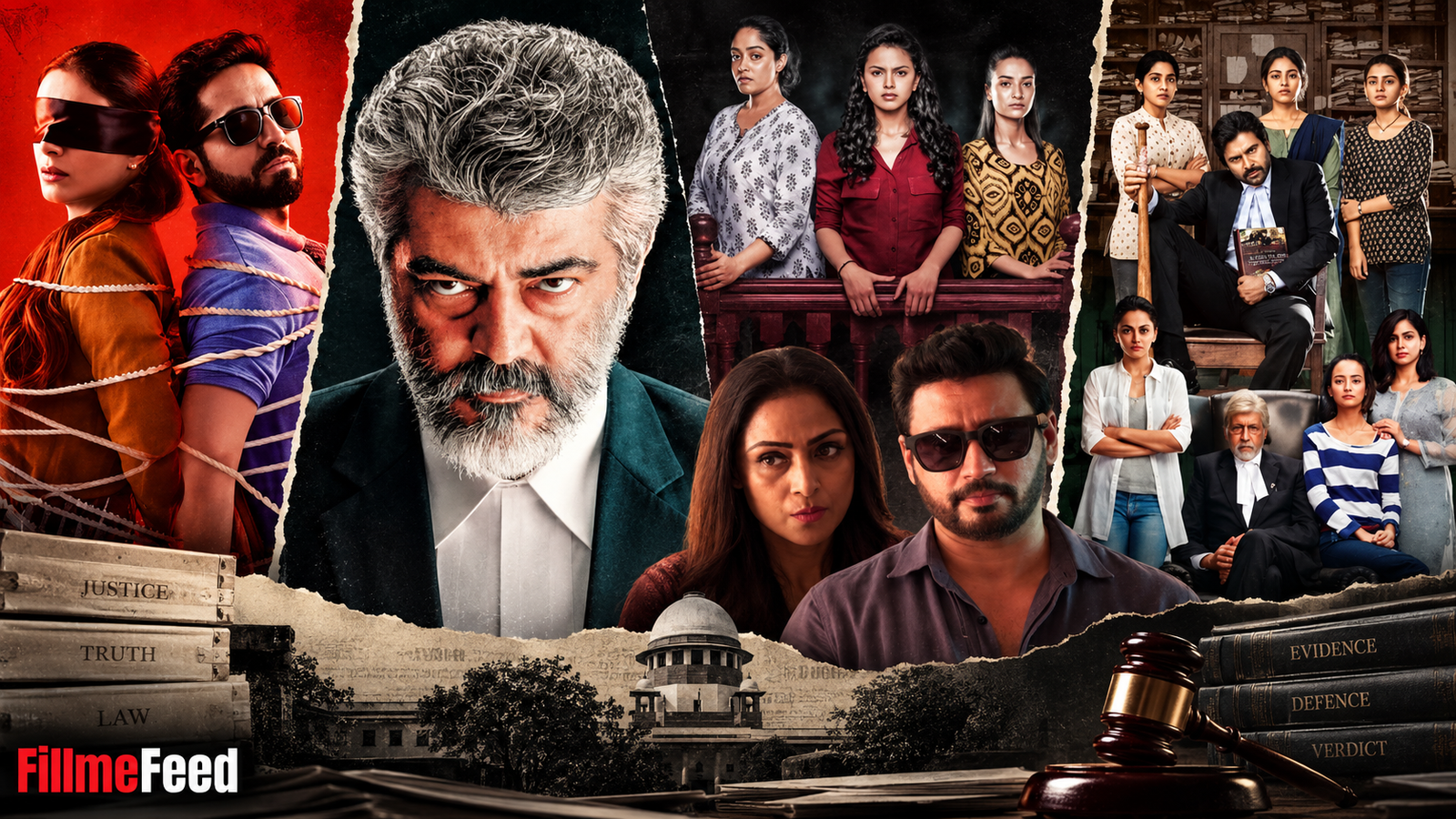
Andhadhun’s triple remake, and why it is the cleanest case
Andhadhun itself began as an unlikely source. Sriram Raghavan was pointed towards L’Accordeur, a 2010 French short film with a similar blind-pianist premise, and built an original Hindi screenplay around that idea with his regular writing team. So the film that ended up getting remade three times over was, in its own way, already a reworking of someone else’s idea, just heavily transformed into something new.
The Telugu version, Maestro (2021), cast Nithiin in Khurrana’s role and Tamannaah Bhatia as the calculating woman at the centre of the murder, the part Tabu played in the original, with Nabha Natesh taking on Radhika Apte’s role. Director Merlapaka Gandhi stuck close to the original’s structure. About three weeks later, the Malayalam version, Bhramam, arrived on Amazon Prime Video with Prithviraj Sukumaran as the pianist, Mamta Mohandas in the Tabu role and Raashi Khanna as his love interest. Cinematographer-turned-director Ravi K. Chandran shot it himself.

Prithviraj was candid in a PTI interview at the time about the risk of remaking a film whose twist was already common knowledge among a large chunk of the audience. His point, in short, was that a remake has to respect the original’s core while still finding a way to make the experience worthwhile for someone who has already seen it. It is a rare instance of a remake’s own lead actor discussing the mechanics of adaptation in public rather than sticking to press-junket enthusiasm.
The Tamil version took the longest to arrive. Producer-director Thiagarajan bought the remake rights in 2019, watched the project pass through two other directors, and finally released Andhagan in August 2024 with his son Prashanth in the lead, Simran as the femme fatale and Priya Anand as the love interest. By the time it reached screens, Andhadhun‘s twist was six years old and had already been remade twice.
What makes this the strongest case for the argument is how mechanical the transfer is. Andhadhun survives translation because its engine is plot logic, not language-specific wit or a star’s screen persona. That is precisely the quality that let Drishyam travel from Malayalam into Hindi, Tamil, Telugu and Kannada without losing its shape. A puzzle box works the same way no matter which language is doing the talking.
Also Read: How a Chhattisgarh’s Theatre Director Taught Hindi Cinema to Talk Like Real People
A Wednesday!, the one where the star crossed over, not the story
A Wednesday! (2008), Neeraj Pandey’s tense two-hander between an anonymous bomb-threat caller and a police commissioner, went south the following year in a way none of Andhadhun‘s remakes did: as a genuine simultaneous bilingual, not a sequential remake made after the fact.
Kamal Haasan produced both versions and played the anonymous caller in each, and the Tamil version (Unnaipol Oruvan) and the Telugu version (Eenadu) released on the same day, 18 September 2009. Mohanlal took the commissioner’s role in Tamil, Venkatesh took it in Telugu, and both versions were shot back to back with the same crew, director Chakri Toleti moving between sets. Kamal Haasan’s own scenes reportedly wrapped in just five days.
That is an unusual structure. Most remakes replace the entire cast and treat the original purely as a script to license. Here, the connective tissue between the two versions was Kamal Haasan playing the same role twice, which is a different kind of remake logic altogether, closer to a dual-language production than a translation.
There is a third data point worth a line, mostly for scope. A Common Man (2013), an English-language Sri Lankan production directed by Chandran Rutnam and starring Ben Kingsley, is also an official remake of A Wednesday!, relocated to Colombo. It picked up a handful of festival prizes on the circuit but was reviewed harshly by mainstream critics, and it never had anything close to the cultural footprint of the Tamil-Telugu version. Worth knowing mainly as proof that the premise travelled even outside the Indian remake ecosystem, not as a title anyone needs to seek out.
Pink and the courtroom drama pattern
Pink (2016), Aniruddha Roy Chowdhury’s consent drama with Amitabh Bachchan as a retired lawyer defending three women against a false case, followed a more conventional remake path: two separate versions, made years apart, each anchored by a major regional star rather than a shared cast member.\
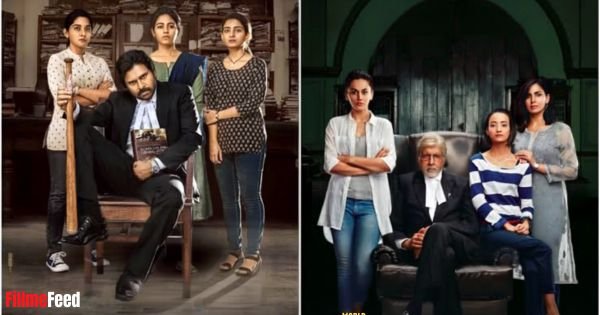
Nerkonda Paarvai (2019) put Ajith Kumar in Bachchan’s role, with H. Vinoth directing and Boney Kapoor producing. Trade estimates put its worldwide gross above ₹150 crore, a solid result for the period. Two years later, Boney Kapoor partnered with Dil Raju on the Telugu version, Vakeel Saab (2021), with Pawan Kalyan marking his return to the screen after a three-year gap for political work. That version opened strongly enough to be one of the biggest releases of a pandemic-hit year, with trade reports placing its worldwide gross at roughly ₹137 crore.
What links these two, beyond the shared source material, is the choice of star. Neither film was sold as a genre spectacle. Both leaned on a star with an established ‘mass hero with a conscience’ image delivering a courtroom monologue built for applause. That is a different transfer logic from Andhadhun‘s puzzle-box mechanics: a message film travels south when a regional superstar is willing to lend the role his own persona, not simply because the plot happens to translate well.
Also Read: Hindi Movie Remakes: 7 South Indian Films That Became Bollywood Hits
Why this direction stays the rarer one
Three confirmed cases across fifteen years, against the dozens of South-to-Hindi remakes over the same stretch, is itself worth sitting with. Hindi cinema’s commercial centre of gravity sits heavily in mass-market action and large-canvas family drama, genres the Tamil, Telugu, Malayalam and Kannada industries already produce at scale and rarely need to import. What does travel from Hindi cinema tends to be its narrower, more script-driven output: plot-mechanism thrillers like Andhadhun and A Wednesday!, or message-driven social dramas like Pink, films built around a tight premise rather than a franchise-scale spectacle.
That is an observation worth stating plainly rather than dressing up as a rule. Three cases is a small sample, and it would be easy to overreach with a tidier theory than the evidence supports. What can be said with confidence is that when a Hindi film does travel south, it is usually because the story itself, not the scale of its production, is doing the work.
Andhadhun getting rebuilt three times over on the far side of the same border that Drishyam crossed the other way is as close as this pattern gets to a clean mirror image: two decade-defining thrillers, each remade repeatedly by the very industries usually credited with being the source rather than the destination for Hindi films remade in South Indian cinema.
Frequently Asked Questions
Has Pink been remade in South Indian languages?
Yes. It was remade in Tamil as Nerkonda Paarvai (2019) with Ajith Kumar, and in Telugu as Vakeel Saab (2021) with Pawan Kalyan.
Is Andhadhun a remake or an original film?
It is credited as an original Hindi screenplay, though director Sriram Raghavan has said he drew inspiration from L’Accordeur, a 2010 French short film. Andhadhun itself has since been remade three times, in Telugu, Malayalam and Tamil.
It was Wednesday! remade in Tamil and Telugu at the same time?
Yes. Unnaipol Oruvan (Tamil) and Eenadu (Telugu) were shot as a simultaneous bilingual with Kamal Haasan in both versions, and both released on the same day, 18 September 2009.
Are Raavan and Raavanan the same film?
They share a director, story and several cast members, but they were shot simultaneously with actors playing swapped roles between the Hindi and Tamil versions, which makes them a dual-production rather than a standard remake.
Which Hindi film has been remade the most times in South Indian languages?
Based on confirmed cases, Andhadhun holds that distinction, with official remakes in Telugu (Maestro, 2021), Malayalam (Bhramam, 2021) and Tamil (Andhagan, 2024).
Which Indian film industry gets remade into Hindi most often?
Tamil and Malayalam cinema account for most of the confirmed, high-profile official remakes discussed in entertainment trade coverage, though Telugu action cinema, particularly the Pokiri lineage, has also fed several major Hindi hits.
About FillmeFeed
FillmeFeed is your go-to destination for the latest updates on Bollywood, Hollywood, Anime, Fashion, Lifestyle, OTT releases, Celebrity News, Movie Reviews, and Trending Stories. We bring readers engaging, well-researched, and up-to-date content from the world of entertainment and pop culture.
FillmeFeed is proudly a part of Fillme Networks, a digital media network committed to creating high-quality content across entertainment, lifestyle, technology, and emerging digital trends.




Pingback: Corecore Gen Z Burnout: Why the Internet Feels Exhausting -